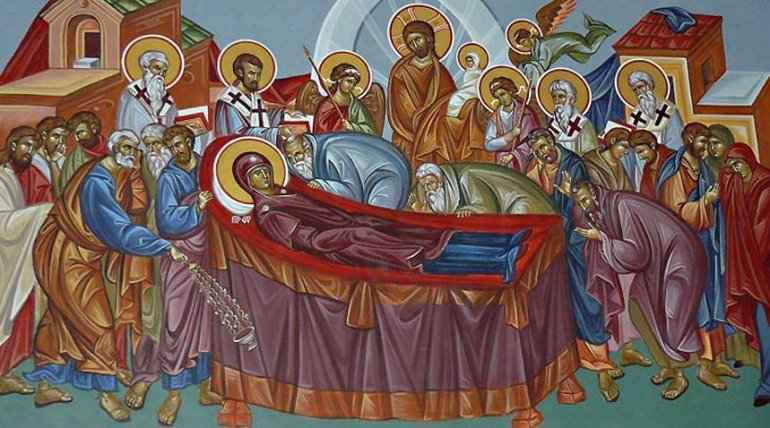
In the Church of Christ, the person of the Most Holy Theotokos has always been accorded particular veneration. One expression of this veneration of the Mother of God is the Dormition Fast, established in her honour.
The figure of the Holy Virgin was revealed to the people of God in the Old Testament through various types and foreshadowings: in Jacob’s Ladder, the Unburnt Bush, the miraculous passage of the Jews through the Red Sea, the vessel containing manna, and Gideon’s fleece. Finally, the Prophet Isaiah foretold:
“Behold, a virgin shall conceive, and bear a son, and shall call his name Emmanuel” (Isaiah 7:14). Because of her immeasurable role in the Birth of our Lord and Saviour Jesus Christ, the Most Holy Lady Theotokos has always been especially venerated, and the Church, in her God-inspired wisdom, gave her the Dormition Fast as an expression of this veneration, preceding the feast of her Dormition. The Dormition Fast is the most recent of the multi-day fasts. It was established following the example of the Most Holy Mother of God, who spent the period before her death in fasting and prayer. In terms of its strictness, this holy fast is less rigorous than Great Lent, but stricter than the Nativity Fast and the Apostles’ Fast.
The Dormition Fast is considerably younger than the feast of the Dormition of the Most Holy Theotokos itself. The first mention of this fast is found in the writings of Saint Theodore the Studite, who says: “Likewise, the fast of the Mother of God should also be observed, with the sole exception of the day of the Transfiguration of the Lord, when oil and fish are permitted.” According to some scholars, this fast was established so that the Eastern Church would have four fasts corresponding to the four seasons of the year, as was the case in the Western Church. During the formation of this fast, the greatest uncertainty concerned the feast of the Transfiguration of the Lord, which has an extended afterfeast and thus, in a certain sense, disrupts the flow and rhythm of the fast. Another important testimony concerning the Dormition Fast is found in the Tomos of Union of 920, which states that married people may receive Holy Communion only three times a year, namely on the feasts of the Resurrection of the Lord, the Nativity of the Lord, and the Dormition of the Most Holy Theotokos. The antiquity of the Dormition Fast is also attested by Athanasius, Bishop of Caesarea in Palestine, and Nikon the Black Mountain, who cite a letter from John, Metropolitan of Nicaea, addressed to Zacharias, the Armenian Catholicos, in which the Dormition Fast is mentioned among other matters. Nikon the Black Mountain likewise bears witness to the Dormition Fast when he states that those who observe it base its tradition on Apostolic Tradition. In response to a question from the monks of Mount Athos concerning the Dormition Fast, Patriarch Nicholas replied, emphasising that the Dormition Fast had existed from an earlier time, but that it had been moved because of pagan fasts that were observed at that time.
Patriarch Nicholas also testifies that people fasted in honour of the Mother of God for the sake of healing, particularly those who were ill.
The work On the Three Forty-Day Fasts, attributed to Anastasius, Patriarch of Antioch, states that, according to the Apostolic ordinances, there was a fast from Pentecost until the Dormition, meaning that there were originally three multi-day fasts. However, because of its length, this fast was divided into the Apostles’ Fast and the Dormition Fast, and thus the Church came to have four multi-day fasts. The Dormition Fast was finally established during the patriarchate of Luke Chrysoberges of Constantinople (1156–1169), at the Council of Constantinople in 1166. Despite all these testimonies concerning the Dormition Fast, there is no mention of it in the Typika until the twelfth century. The first mention is found in the Typikon of the Monastery of Saint Nicholas of Kasoulon in Southern Italy, dating from 1174. This Typikon records that the fast in honour of the Mother of God did not begin on 1/14 August because of the feast of the Holy Maccabean Martyrs, but instead began on 2/15 August. Interestingly, no later Typikon mentions the Dormition Fast, but only the three multi-day fasts. As far as liturgical practice is concerned, among the multi-day fasts, it is only during Great Lent (the Paschal Fast) that we find significant liturgical peculiarities. With regard to the Dormition Fast, it is interesting to mention the practice of the Church of Greece, where during the Dormition Fast, following Vespers, a Canon of Supplication to the Most Holy Theotokos is served. Its purpose is to offer more fervent prayer to the Most Holy Mother of God during the fast established in her honour.
Any mention of fasting also implies an emphasis on its inseparable connection with the Holy Eucharist, since every fast is an integral part of the liturgical life of the Church. Every Christian ascetic effort during the fast, together with prayer, finds its fullness in active participation in the Divine Liturgy. Fasting in itself has never been an individual undertaking; rather, it has always been sustained by the liturgical experience of the Church, finding its crown in the Eucharistic assembly.
Branislav Ilić, theologian
Source: https://www.tvhram.rs/